
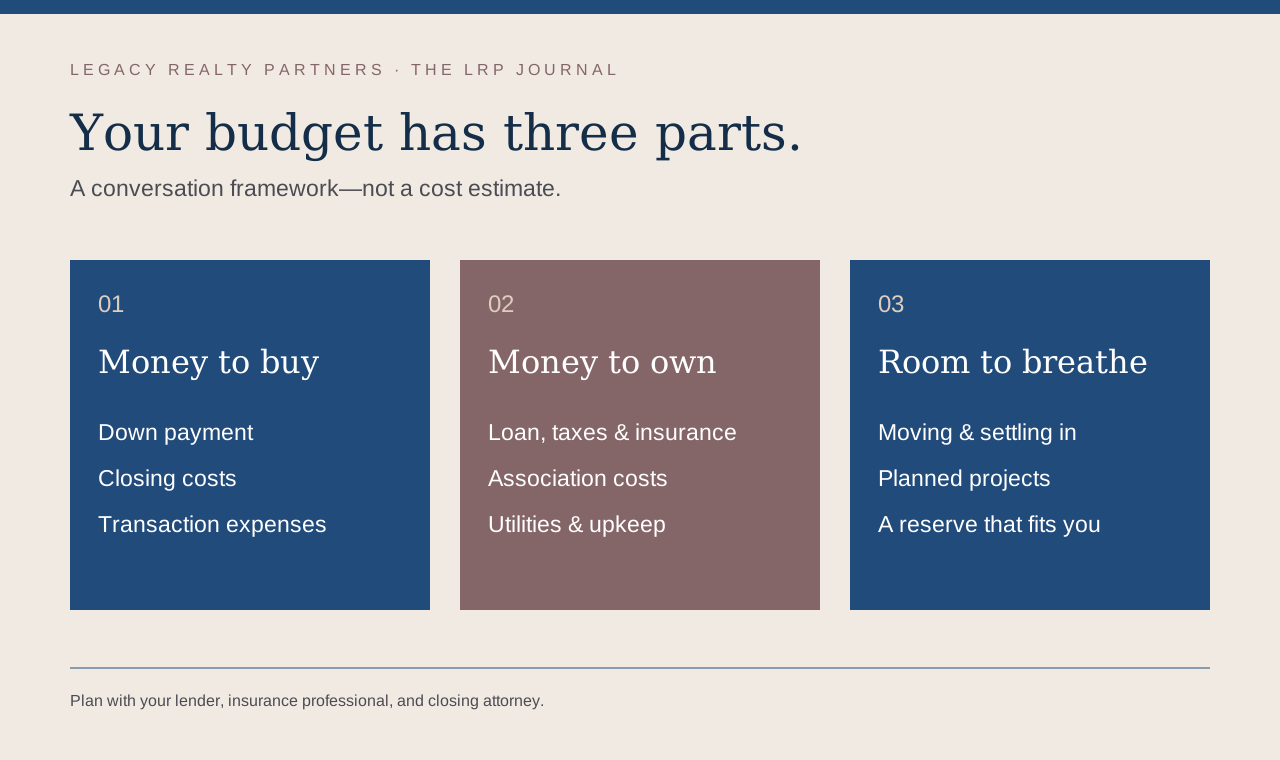
A house should support your life, not swallow every dollar you have available. When you are planning a purchase, I want the conversation to include the move and the months afterward—not only the amount needed for a down payment. A little organization at the beginning can make the choices feel much less overwhelming.
Build a budget for buying the home, owning it, and continuing to enjoy your life.
Separate three different questions.
I would start with three columns: money needed to buy, ongoing ownership expenses, and the savings you want to keep. This is a conversation framework rather than a fixed formula. Your lender, insurance professional, and closing attorney can help confirm the actual figures.
The point is to stop one attractive number from taking over the decision. A payment that looks manageable does not answer how much cash you need to finish the purchase. A large down payment does not tell us whether you will feel comfortable after the movers leave.
Understand the cash needed to complete the purchase.
The CFPB’s Loan Estimate guide explains that estimated cash to close reflects the down payment and closing costs, adjusted for deposits already paid, credits, and other items. Ask your lender to walk through those lines so you do not count the same money twice.[1]
Keep a separate record of expenses paid along the way, including inspections and other services relevant to the property. The timing matters as much as the total. Your signed contract and the professionals handling the transaction determine what is due and when; a generic online checklist cannot establish that for you.
Budget for owning the home, not just financing it.
The CFPB recommends accounting for taxes, insurance, applicable mortgage insurance, association fees, utilities, repairs, and maintenance when planning homeownership. Some expenses can change over time.[2]
Take that list to the actual properties you are considering. Ask questions about the systems, exterior responsibilities, and expenses that are not obvious from the photographs. An older roof and a large yard create different planning conversations from a townhome where an association handles some exterior work. Confirm the details rather than assuming the label tells the whole story.
Compare loan choices on the same basis.
Request written Loan Estimates and review the loan type, rate, fees, projected payment, and cash to close together. The CFPB’s explainer shows where to find those items and encourages comparison across lenders.[1]
My practical suggestion is to keep a one-page comparison and write down the questions you still need answered. If an incentive or credit looks especially appealing, ask what conditions come with it and how the entire offer changes. A lender can explain the financing trade-offs; we can keep the property decision connected to your priorities.
Decide what you want life to feel like after closing.
Think about the first ordinary month in the new home. Will you be buying furniture immediately? Is a project necessary before you move in? What amount of savings helps you sleep at night? Those are personal decisions worth making deliberately.
Our mortgage calculator can help you explore assumptions, but it is not a loan quote and does not include every expense. Use it to start the conversation, then replace assumptions with written figures. You do not need to stretch to the edge of an approval just because the approval exists.
Sources & further reading
Researched and verified November 12, 2026. Commentary reflects Maya’s approach; source links support the factual information.
Maya Galletta
Personal guidance for buying, selling, and finding your place in the Triangle. Legacy Realty Partners · RE/MAX United.
Talk with Maya ↗