“How is the market?” is a useful opening question. “Which market, which month, and which kind of home?” gets us closer to an answer you can use. Here is a November 12 reading of October listing data for two Triangle metros, followed by how I would bring the conversation back to your move.
Data period: October 2026. Publication and verification: November 12, 2026. This is a dated snapshot, not a live market feed. Source data may later be revised.
Use regional data for context and property-specific evidence for your decision.
The October listing snapshot
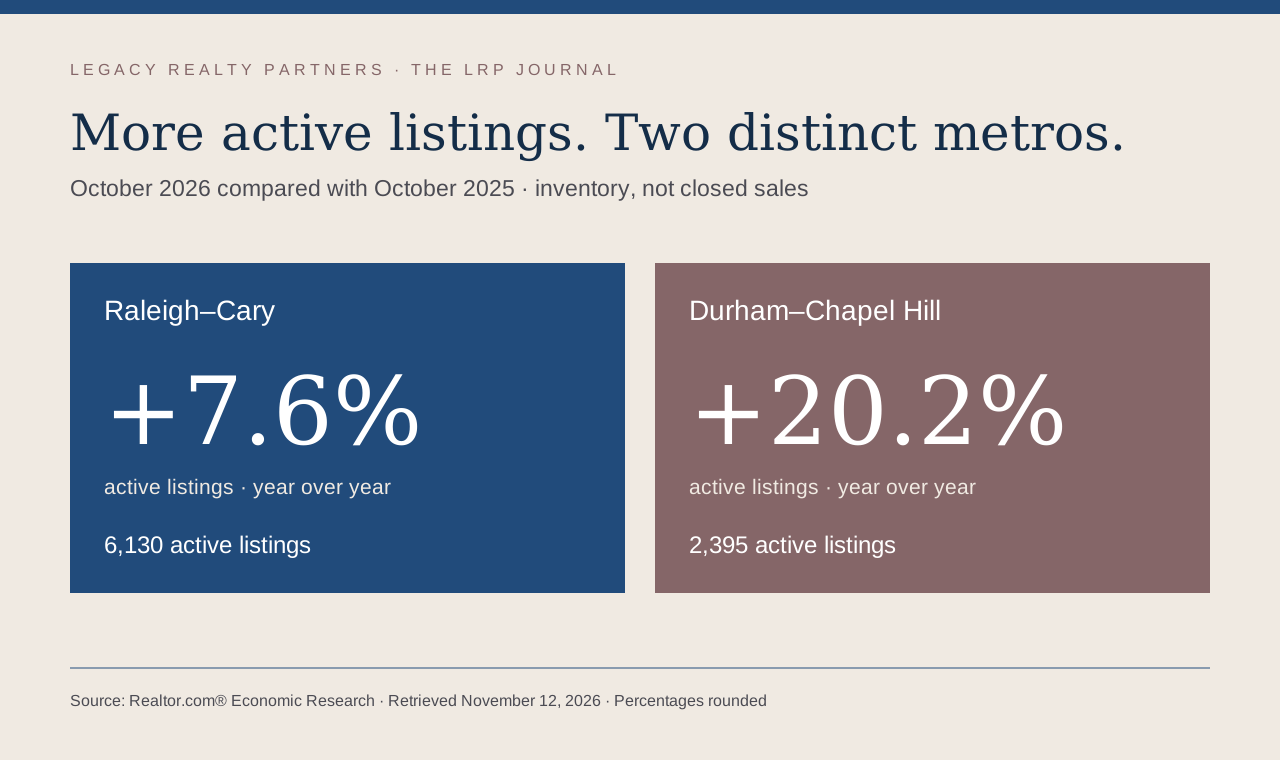
Realtor.com® Economic Research’s October 2026 file reports 6,130 active listings in Raleigh–Cary, up 7.6% from a year earlier. Durham–Chapel Hill had 2,395, up 20.2%. Median listing prices were $445,000 and $460,000 respectively, down 2.6% and 3.2% year over year.[1]
Median time on market was 64 days in Raleigh–Cary and 60 in Durham–Chapel Hill. New listings were lower than a year earlier in both metros, even as active inventory was higher. Those measures describe different things: homes entering the market versus the supply available during the reporting period.[1]
| Metric | Raleigh–Cary | Durham–Chapel Hill |
|---|---|---|
| Active listings | 6,130 | 2,395 |
| Active listings, year over year | +7.6% | +20.2% |
| Median listing price | $445,000 | $460,000 |
| Listing price, year over year | −2.6% | −3.2% |
| Median days on market | 64 | 60 |
| New listings | 1,740 | 660 |
Source: Realtor.com® Economic Research. Changes compare October 2026 with October 2025. These are metro listing measures, not closed-sale prices.
Read the labels before drawing a conclusion.
These are listing statistics, not closed-sale prices. The two metro areas are separate geographies, not a single “Triangle average.” A median can also shift when the mix of homes changes. It does not establish how much a particular home gained or lost in value.[1]
My perspective for buyers
Start by identifying the homes that actually fit your needs. Then compare condition, layout, ongoing costs, and the terms you are comfortable offering. I would not turn a regional headline into a fixed discount to demand from every seller.
A useful next step is a side-by-side review of your shortlist. What makes each property different? What needs verification? Which compromises would you be happy with six months after moving? Those questions keep the decision grounded in your own goals.
My perspective for sellers
I want a pricing conversation to include the homes a buyer could choose instead of yours. The preparation plan, the photographs, and the asking price need to tell a consistent story. None of those pieces should be chosen in isolation.
Before launch, we can agree on what feedback to collect and when to review it. If the response is different from what we expected, we will have a framework for discussing the next step rather than reacting to a single showing or comment.
Keep the budget personal.
The CFPB recommends allowing for the full cost of ownership, including expenses beyond principal and interest.[2] That remains a useful discipline regardless of the headline. My goal is a move you can explain and feel comfortable with—not a decision made to keep up with the news.
If you want to understand what this means for your property or search, let’s narrow the geography, home type, and price range together. That is where a broad market update becomes a practical conversation.
Sources & further reading
Researched and verified November 12, 2026. Commentary reflects Maya’s approach; source links support the factual information.

Maya Galletta
Personal guidance for buying, selling, and finding your place in the Triangle. Legacy Realty Partners · RE/MAX United.
Talk with Maya ↗